Yard Regrading and Swale Construction in Charleston
Regrading and swale construction in Charleston to move standing water away from your foundation, over heavy clay soil and seasonal downpours.
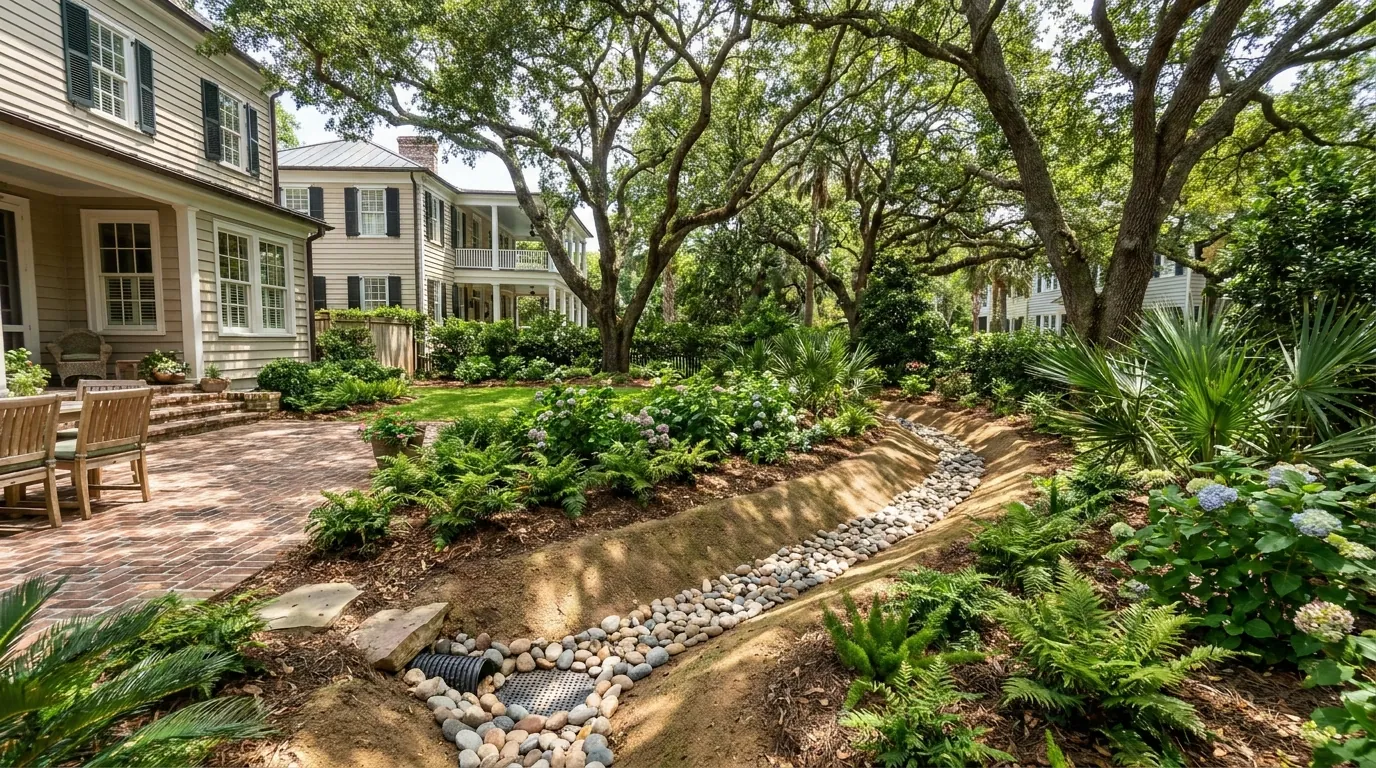
When the ground itself is the problem
A buried pipe only helps if the water can reach it. In many Charleston yards the real trouble is the shape of the ground: a lawn that slopes toward the house, a flat low spot that never drains, or a patio and driveway that send sheet water back toward the foundation. When that is the case, regrading and a shallow surface channel called a swale often do more than any single drain line.
The warning signs are easy to recognize. Water stands in the same low spots for a day or more after a storm. Mulch and pine straw wash out of beds and collect against the house. A crawlspace or garage slab stays damp. Grass thins or turns to moss where the ground stays wet. Downslope neighbors' runoff crosses your lot because there is no defined path to carry it to the street or a low area.
Regrading corrects the slope of the soil so the first few feet around the house fall away from the walls, and a swale gives the collected water a gentle, continuous path to somewhere it can safely go. Done together, they handle the large-volume sheet flow that our intense summer downpours produce — the flow that overwhelms small drains.
What the work involves
Regrading and swale construction is earthwork first and planting second. The sequence matters because fall and outlet have to be right before anything is covered back up.
-
Survey the existing fall
We shoot elevations across the yard to find where water actually goes versus where it should go. This tells us how much soil has to move and whether a swale can reach a usable low point, the street, or a drain outlet.
-
Establish positive slope at the foundation
The ground within the first several feet of the house is reshaped to fall away from the walls. On Charleston's heavy clay this is especially important, because clay sheds water rather than absorbing it, and a flat or reversed slope parks that water against the foundation.
-
Cut and shape the swale
A broad, shallow channel is cut along the path the survey identifies. It is given continuous fall from start to finish so water keeps moving and never ponds in the bottom. The grade is gentle enough to mow over.
-
Set the outlet
The swale has to end somewhere that accepts water — a street gutter, a ditch, a lower corner of the lot, or a buried line. Where a surface outlet is not available, the swale can feed a catch basin or a dry well.
-
Stabilize and plant
Reshaped soil and the swale bottom are seeded, sodded, or planted so the new grade holds through the next heavy rain. Until vegetation takes, the bare soil is protected from washout.
How Charleston's soil and rain change the job
Lowcountry clay and compacted subsoil behave very differently from sandy loam. Water does not percolate down through it quickly, so almost everything that lands during a downpour has to leave across the surface. That makes grading and swales unusually effective here — but it also means the fall has to be generous, because clay holds a thin film of water in any dip you leave behind.
Our rainfall arrives in bursts. An afternoon thunderstorm can drop more water in an hour than a drain designed for slow seepage can carry. A swale shines in that situation because it moves high volume quickly across a wide path. Flat lots near the coast and in low neighborhoods add another challenge: there may be very little difference in elevation to work with, so finding and protecting the outlet is the hardest part of the design.
Regrading frequently pairs with other drainage work. A swale can deliver water to surface catch basins and area drains at low points, and a French drain can pick up the groundwater that grading alone cannot reach. We look at the whole yard rather than one symptom.
Find out what your yard's grade is really doing
Tell us where the water stands and we will come look at the slope, the low spots, and where the runoff can be sent. Call to set up a site visit in Charleston or the surrounding towns.
Serving Charleston, Mount Pleasant, North Charleston, Goose Creek, Summerville, Hollywood, and Ravenel.
Frequently asked questions
Will regrading alone fix my standing water, or do I also need a drain?
It depends on where the water comes from. If the problem is surface runoff and a yard that slopes the wrong way, regrading and a swale often resolve it. If water is also rising from saturated clay below the surface, a French drain is usually added to intercept it.
How much slope does a swale need?
Enough that water keeps moving from one end to the other without ponding in the bottom. On flat Lowcountry lots that can be tight, which is why we survey the elevations first and sometimes route the swale to a catch basin or dry well when there is no surface outlet.
Can you regrade without killing my lawn?
Reshaped areas are reseeded or sodded as part of the work, and the disturbed soil is stabilized until growth takes hold. The footprint of disturbance is kept to what the grading actually requires.
Where does the water go after you build the swale?
To an approved low point — a street gutter, a ditch, a lower corner of the lot, or a buried line, catch basin, or dry well. Identifying and protecting that outlet is the part of the design we settle before any digging begins.