Downspout Extension and Buried Drain Lines in Charleston
Downspout extension and buried drain lines in Charleston, SC. Move concentrated roof water away from the foundation to a safe outlet on clay soil.
Why roof water is often the real problem
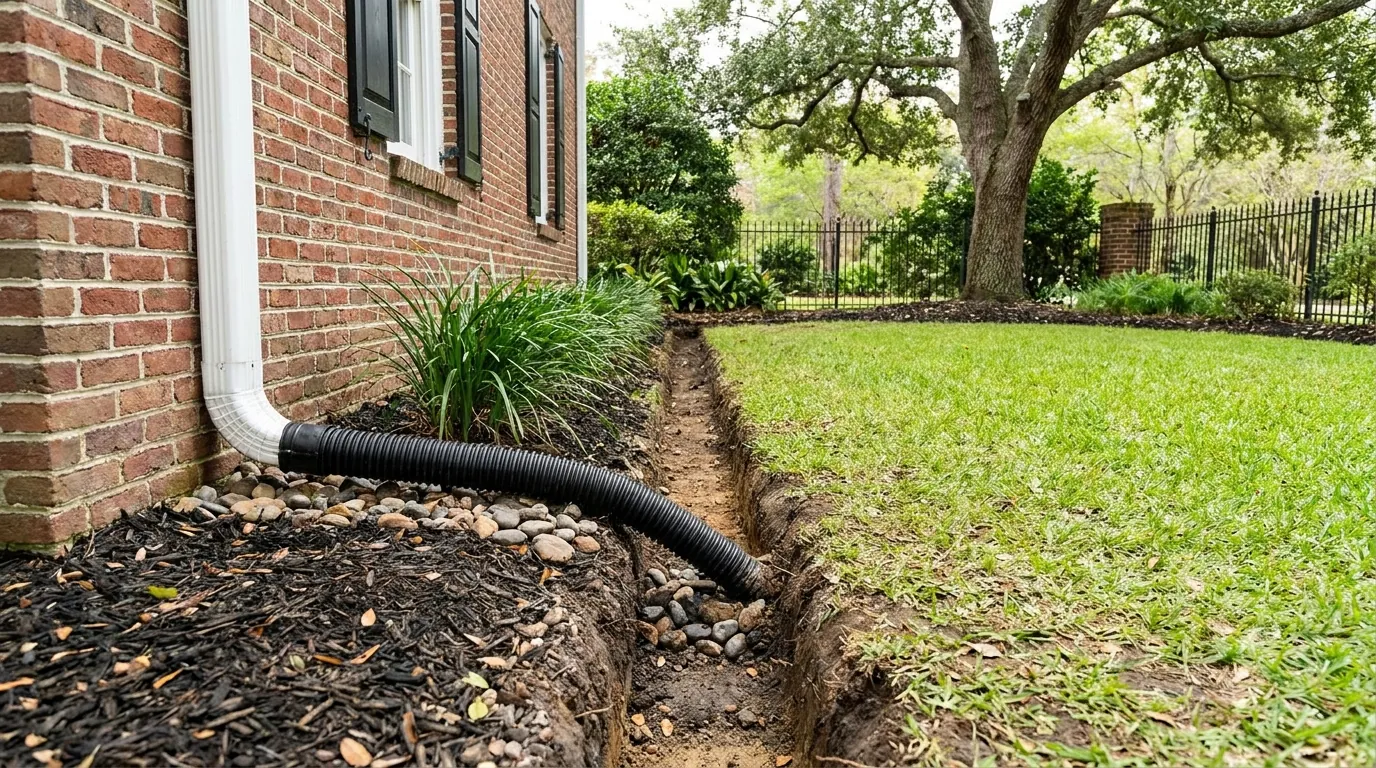
A single downspout can concentrate the runoff from hundreds of square feet of roof into one spot at the base of your house. On Charleston's heavy clay, that water does not soak away — it pools at the foundation, finds the easy path into a crawl space or against a slab, and erodes the beds and mulch nearby. Extending the downspout and burying the line carries that concentrated flow underground to a point where it can safely leave the property.
The warning signs are specific: soil washed away or splashed up on siding under a downspout, a splash block that still leaves a puddle, mulch repeatedly pushed out of a bed below a gutter, settling or a damp line along the foundation near a downspout, and water showing up in a crawl space on the gutter side of the house. These usually point to roof water, not groundwater, and the fix is to get that water away from the wall before it causes more.
Buried downspout lines often share an outlet with other drainage. We frequently tie them into the same discharge as a french drain or combine them with surface catch basins and area drains so roof water and yard water leave together. Handling the roof water first often reduces how much the rest of the system has to move.
How we extend and bury a downspout line
The goal is a solid, sealed path from the gutter to an outlet that clears quickly after rain.
-
Map the roof areas and outlet
We note how much roof each downspout drains and where the water should end up — a daylight point at a lower grade, a pop-up emitter in the lawn, or a dry well. The outlet and the fall available dictate the pipe route.
-
Transition from downspout to buried pipe
The downspout is connected to solid, smooth-wall pipe at or just below grade with a sealed fitting, so roof water enters the line cleanly instead of spilling at the base of the wall.
-
Trench with continuous downhill pitch
The line runs away from the foundation with steady fall and no sags, because any low spot in a solid roof-water line holds water and sediment. On flat lots keeping that pitch is the main challenge.
-
Set the outlet
At the end we install a daylight outlet, a pop-up emitter that opens under pressure and reseats when flow stops, or a dry well sized for the roof area. The outlet is chosen for the lot, not the other way around.
-
Backfill and verify flow
We backfill, restore the surface, and run water from the gutter through the full line to confirm it reaches the outlet without backing up.
Charleston soil, rain and roof runoff
Smooth-wall pipe matters here because roof water carries grit, shingle sediment, and leaves, and our heavy rain delivers it in volume. Smooth pipe moves that debris through; corrugated pipe catches it and can clog over time. Keeping the line sealed and solid from the downspout to the outlet is what keeps roof water from re-entering the soil right next to the foundation.
Pop-up emitters are a common Charleston choice when there is no lower edge to daylight the pipe. They stay closed until roof water pressure lifts the lid, then reseat so grass clippings and animals stay out. On tight clay with no fall at all, a dry well gives the water somewhere to collect and release slowly, but it has to be sized for the roof area feeding it and for soil that accepts water slowly. We walk through these outlet choices on site. If you want to understand how these pieces compare before we visit, our comparison of french drains, surface drains and dry wells is a useful starting point, and the pop-up and dry well options are also covered on our dry well and pop-up emitter page.
Get roof water away from your foundation
If downspouts are dumping water at the wall, call to schedule a visit. We will check the roof areas, the fall, and the outlet options, then explain what burying the lines would involve.
Serving Charleston and nearby towns including Mount Pleasant, Goose Creek, and Summerville.
Frequently asked questions
How far from the house should a downspout line discharge?
Far enough that water leaves the foundation zone and reaches a point where it can drain away — the exact distance depends on your grade and where a lower outlet exists. On flat Charleston lots that often means running the line to a pop-up emitter or dry well because there is no nearby daylight point.
Can I use corrugated pipe for buried downspouts?
We use smooth-wall solid pipe for roof-water lines because it moves shingle grit and leaves through instead of trapping them. Corrugated pipe tends to collect sediment in its ridges and can clog, which is a real issue given how much debris our heavy rain washes off a roof.
What is a pop-up emitter and when do you use one?
A pop-up emitter is a lid at the end of a buried line that stays closed until roof water pressure lifts it, then reseats when flow stops. We use them when there is no lower edge of the lot to daylight the pipe, which is common on flat Charleston yards.
Will burying downspouts fix my crawl space moisture?
If the crawl space is wet on the gutter side of the house, moving that concentrated roof water away often makes a clear difference. Crawl space moisture can also involve grading and groundwater, so we look at the whole water path rather than assuming downspouts are the only cause.