Surface Catch Basins and Area Drains in Charleston
Surface catch basins and area drains for Charleston yards. Grated inlets that capture ponding water at low spots and carry it off clay soil by buried pipe.
When surface water needs a place to go
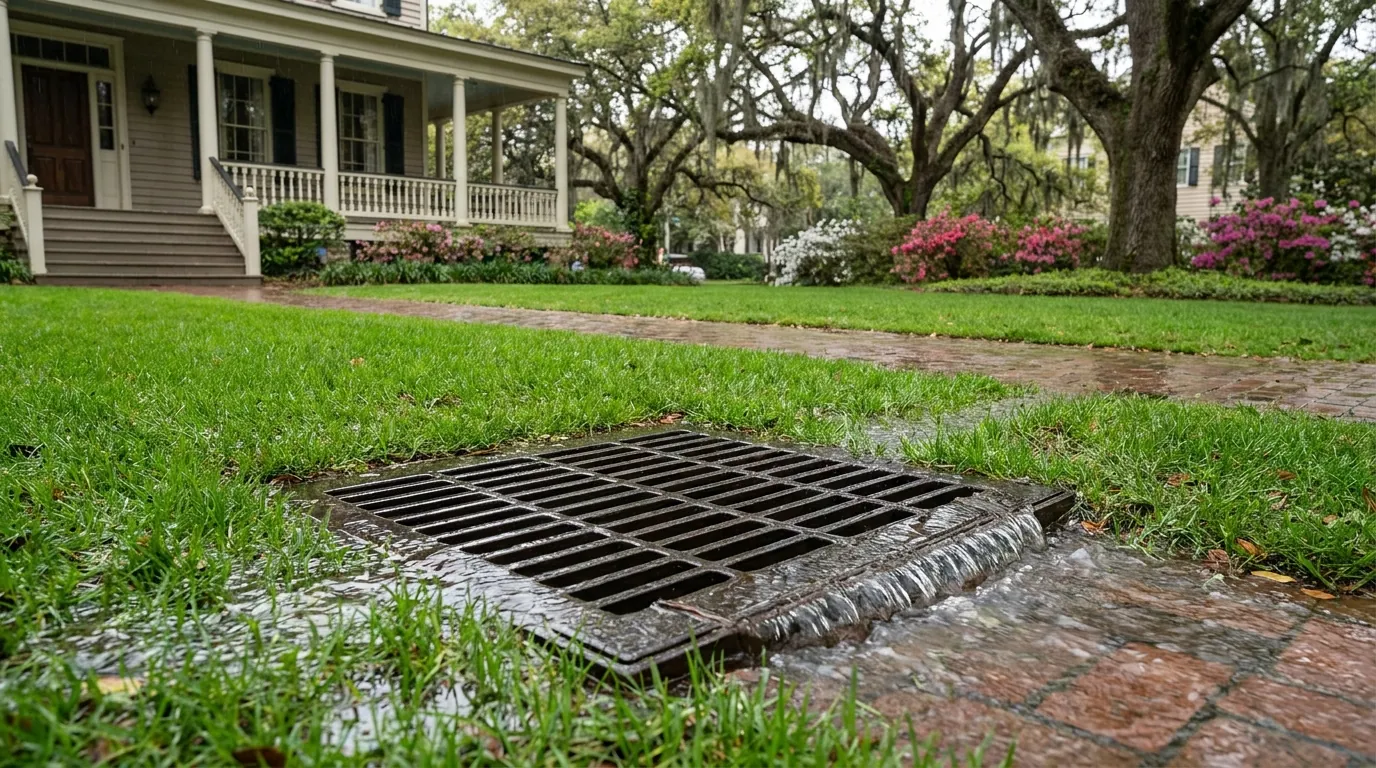
A catch basin is a grated box set into a low point of the yard. Water flows across the surface, drops through the grate into the basin, and then runs out a buried pipe to a lower outlet. Area drains work the same way at a smaller scale — a channel or a round grate placed where water concentrates, like the base of a patio, a planting bed, or a narrow side yard between houses.
This is the right tool when the problem is water on top of the soil rather than water moving through it. In Charleston, our heavy clay and compacted subsoil mean rain often has nowhere to soak in. It sheets across the lawn and ponds in the lowest spots — the dip behind the garage, the corner where two slopes meet, the strip along a fence. If you have birdbath puddles that sit for a day, grass that stays matted and yellow, or mud tracked onto a patio after every storm, a catch basin captures that water at the surface instead of letting it linger.
Catch basins often work alongside subsurface drainage rather than instead of it. A french drain handles water moving through the soil toward the foundation, while a catch basin grabs the ponding at the surface. Many Charleston yards need both tied into one outlet. We also tie basins into downspout extension and buried drain lines so roof water and surface water share the same discharge.
How a catch basin system goes in
The work centers on capturing water at the right spot and keeping the buried line flowing.
-
Locate the true low points
We watch how water moves across the yard and shoot grades to find where it actually collects — which is not always where it looks worst. A basin set in the wrong spot leaves a puddle six feet away, so placement comes first.
-
Confirm the outlet and the fall
The buried line from the basin needs steady downhill pitch to a lower outlet — daylight, a dry well, or a storm structure. On flat Charleston lots this is the hardest part, and it decides whether a basin will drain or just fill up.
-
Set the basin to grade
The grate is set slightly below the surrounding soil so water runs into it rather than past it. We shape the ground around the grate into a gentle bowl so the low spot feeds the basin from every direction.
-
Run and connect the buried pipe
Solid pipe carries water from the basin to the outlet with no uphill sags. We use smooth-wall pipe on longer runs where flow matters, and keep cleanout access where the layout allows.
-
Backfill, restore, and test
The trench is backfilled and the surface restored with sod or the existing finish. We run water to the basin and watch it exit the outlet before considering the job done.
What Charleston conditions mean for catch basins
Because our soil sheds so much of the rain it receives, catch basins see heavy, fast flow during summer storms and tropical downpours. An undersized grate or a line that is too small will surcharge — water backs up through the grate and the puddle returns. We size the inlet and pipe to the area of yard draining into it, not to a one-size box.
Sediment is the other Charleston factor. Clay and silt wash in with the water, and a basin that is never cleaned will fill with muck and stop taking water. A proper sump below the pipe outlet in the basin gives silt a place to settle, and an accessible grate makes periodic cleaning simple. Flat lots are the real constraint here: when there is no fall to a daylight outlet, the water has to go to a dry well, and that only works if the surrounding soil can accept it between storms. We assess all of this on site before recommending basins alone or a combined system.
Stop the puddles that keep coming back
If the same low spots pond after every rain, call to schedule a visit. We will locate the true low points, check the fall to an outlet, and explain what a catch basin system would involve for your yard.
Serving Charleston, Mount Pleasant, North Charleston, Goose Creek, Hollywood, Ravenel, and Summerville.
Frequently asked questions
What is the difference between a catch basin and a french drain?
A catch basin captures water pooling on the surface through a grate, while a french drain collects water moving through the soil using a buried perforated pipe in gravel. Many Charleston yards need both because clay soil produces both surface ponding and subsurface flow toward the foundation.
Why does my catch basin still leave a puddle nearby?
Usually the basin was set too high or placed off the true low point, so water pools before reaching the grate. The ground around a basin should slope gently into it from all sides, which is why we shape the surrounding grade when we install one.
Do catch basins need maintenance?
Yes. In our silty clay soils sediment and leaves collect in the basin, and a clogged grate or filled sump will stop water from draining. A basin with an accessible grate and a settling sump is straightforward to clear periodically.
What if my yard is too flat to drain to daylight?
On flat lots with no lower edge to discharge to, the line can run to a dry well or a pop-up emitter. That approach depends on the surrounding soil being able to accept the water between storms, which we check during the site visit.