Driveway and Window Well Drainage in Charleston
Driveway trench drains and window well drainage in Charleston to stop runoff from flooding garages, basements, and foundation walls.
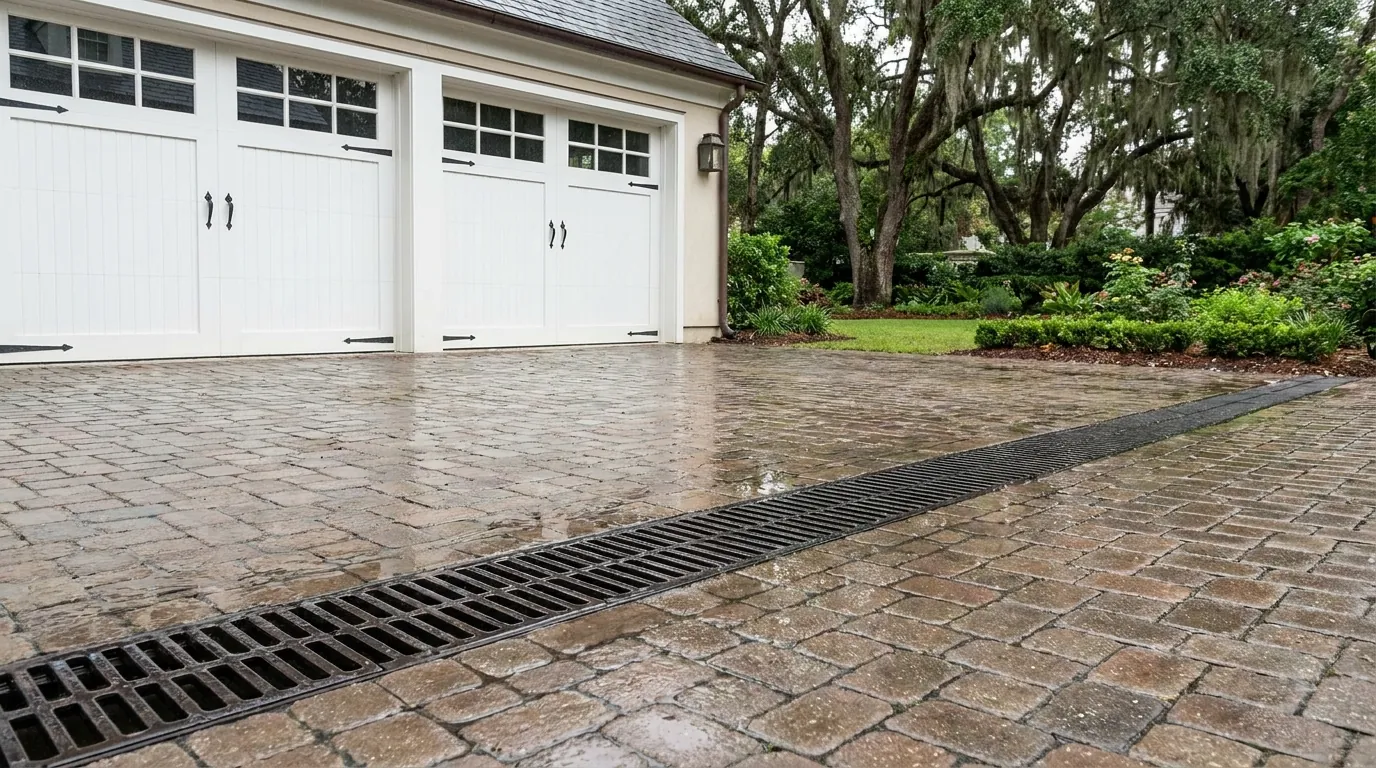
Where hard surfaces send water the wrong way
Driveways and window wells concentrate water. A driveway is a wide paved surface that sheds everything that lands on it, and if it slopes toward the garage, that water heads straight for the slab and the threshold. A window well is a pit against the foundation; without drainage it fills during a hard rain and pushes water through the frame or the wall.
The warning signs show up fast in Charleston's heavy storms. Water sheets under the garage door and pools on the slab. A stain line marks how high the water rose against the apron. Window wells hold standing water or silt after a storm, and the sill inside the wall shows moisture. Pavers heave and settle where water repeatedly saturates the base.
The fix is to intercept the water at the hard surface itself, before it has a chance to flow toward an opening. A trench drain across the driveway apron catches sheet flow in a line; a drain in the bottom of a window well carries water down and away instead of letting it rise. Both tie into a buried line that moves the water to a safe outlet.
What the work involves
Driveway and window well drainage is about catching water at a specific choke point and giving it a buried path out. The details depend on the pavement and the foundation.
-
Identify the low line
We find exactly where water crosses the driveway or enters the garage and where each window well sits relative to grade. That determines where a trench drain goes and how deep the outlet line has to run.
-
Cut in the trench drain
A channel is cut across the apron or low point of the driveway and a trench drain with a grate is set flush with the surface, pitched so water runs to one end. Concrete or paver edges are rebuilt around it so the drain sits level and secure.
-
Drain the window wells
Each affected well gets a drain at the bottom connected to a buried line, and the gravel in the well is refreshed so water moves down instead of standing. This keeps the water level in the well below the window sill during a storm.
-
Run the buried outlet line
The trench drain and window well drains tie into a solid pipe that carries the collected water away from the house to a daylight outlet, a pop-up emitter, a catch basin, or a dry well — somewhere it will not circle back.
-
Restore the surface
Pavement, pavers, and landscaping disturbed during the dig are reset, and the grates are checked to confirm water enters the drain and nothing ponds alongside it.
How Charleston conditions change the job
Because the clay under most Charleston driveways sheds water instead of absorbing it, a paved surface combined with clay subsoil produces fast, high-volume runoff. A trench drain here has to be sized and pitched for that burst flow, not for a trickle. Where a driveway sits low relative to the street, the water has nowhere to go on its own, so the buried outlet line and its destination are the critical part of the design.
Window wells are a particular problem on homes with below-grade space near the coast, where the water table is high and heavy rain saturates the soil quickly. If the well's drain outlet is not low enough or the receiving line is undersized, the well fills faster than it can empty. We set the outlet depth and the buried line to handle the conditions on your specific lot.
This work often connects to the rest of a yard's drainage plan. The buried line from a trench drain can share an outlet with downspout and buried drain lines, and where there is no surface outlet it can discharge into a dry well and pop-up emitter. We design the whole path, not just the grate you see.
Stop water at the driveway or the window well
If water sheets into your garage or stands in a window well after every storm, call to set up a look at where it enters and where it can be sent instead.
Serving Charleston, Mount Pleasant, North Charleston, Goose Creek, Summerville, Hollywood, and Ravenel.
Frequently asked questions
Why does water run into my garage even though the driveway looks flat?
A driveway that reads as flat often has a slight pitch toward the house, and on Charleston clay nearly all the rain that lands on it runs off rather than soaking in. A trench drain across the low line catches that sheet flow before it reaches the threshold.
Can a trench drain be added to an existing concrete driveway?
Yes. A channel is saw-cut into the existing slab, the drain is set flush, and the concrete is patched around it. The key decisions are where to place it and where the buried line will carry the water.
My window well fills up during heavy rain — what fixes that?
A drain at the bottom of the well connected to a buried outlet line gives the water a path down and away, and refreshing the gravel helps it move instead of pond. Setting the outlet low enough for our high water table is what keeps the level below the sill.
Where does the water from the driveway drain end up?
It ties into a solid buried pipe that discharges at a daylight outlet, a pop-up emitter, a catch basin, or a dry well, away from the foundation. We choose the destination based on your grade and whether a surface outlet exists.