Dry Well and Pop-Up Emitter Installation in Charleston
Dry well and pop-up emitter installation in Charleston to give buried drain lines a safe outlet when there is no ditch or street to drain to.
The missing piece: where the water actually goes
Every drain line has to end somewhere. On a lot with a street gutter or a ditch at the property line, that is simple. But many Charleston lots are flat, sit low, and have no obvious place to send collected water. When there is no surface outlet, a dry well or a pop-up emitter becomes the outlet that makes the rest of the system work.
The signs that your outlet is the problem are specific. A buried line that was installed to carry away downspout or French drain water backs up and surfaces near its upstream end. Water trickles from the end of a pipe and simply re-saturates the same corner of the yard. A previously installed drain stopped moving water and no one can find where it was supposed to discharge. In each case the collection is fine — the destination is not.
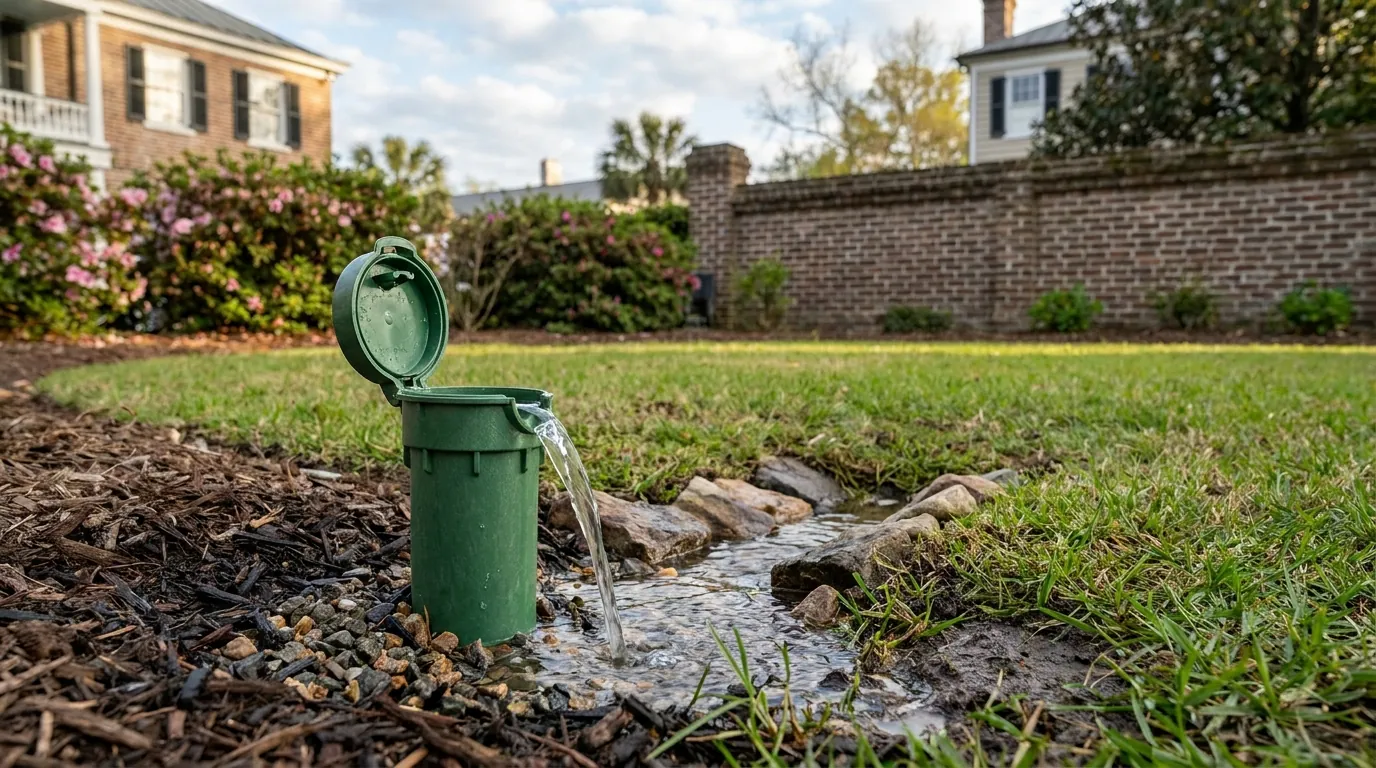
A dry well is a buried chamber surrounded by gravel that receives water from a drain line and holds it while it soaks into the surrounding soil. A pop-up emitter is a hinged cap at the end of a buried line that stays flush with the lawn and lifts to release water at the surface when the line is full, then closes to keep out debris and animals. Which one fits depends entirely on how your soil accepts water.
What the work involves
Choosing and placing the outlet is a design decision driven by the soil and the grade. The installation follows from what the ground will accept.
-
Test how the soil accepts water
Before recommending a dry well, we check how quickly water drains from a test hole. Heavy Charleston clay accepts water slowly, which decides whether a dry well is realistic, how large it must be, or whether a surface emitter is the better outlet.
-
Locate the outlet away from the house
The dry well or emitter is placed well downslope of the foundation and away from the drain lines feeding it, so the released water does not circle back toward the structure.
-
Excavate and set the dry well
For a dry well, a chamber is dug to the depth the soil test supports, lined with filter fabric, filled with washed stone around a perforated basin, and connected to the incoming line. The size is matched to the volume the system has to handle in a heavy storm.
-
Set the pop-up emitter
For a pop-up outlet, the buried line is pitched to carry water to the emitter, which is set flush in the lawn at a lower spot. The cap lifts under pressure to release water across the grass, then settles closed.
-
Test the full run
Water is run through the connected system to confirm it moves from the collection point to the outlet and discharges where intended rather than backing up or pooling.
How Charleston's clay changes the choice
Dry wells depend on the surrounding soil to absorb water, and that is exactly where the Lowcountry works against them. Heavy clay and compacted subsoil take water in slowly, and a high water table near the coast can leave the soil already saturated during the storms when you need the well most. On those lots an undersized dry well simply fills and stops accepting water, so if a dry well is used at all it has to be sized generously and placed where the soil test supports it.
Because of that, a pop-up emitter is often the more dependable outlet on flat Charleston lots — it releases water at the surface where it can spread and run off rather than relying on the ground to swallow it. The right answer comes from the soil test and the grade, not from a preference. In some yards a dry well handles ordinary rain while a swale or surface path carries the overflow from a cloudburst.
This outlet work is what completes the rest of a drainage plan. It is the discharge point for a French drain or for downspout and buried drain lines. We size and place the outlet as part of the whole system so collected water genuinely leaves the yard.
Give your drains a real outlet
If your yard is flat, has no ditch or gutter nearby, or an existing line has nowhere to discharge, call to set up a soil check and a plan for where the water should go.
Serving Charleston, Mount Pleasant, North Charleston, Goose Creek, Summerville, Hollywood, and Ravenel.
Frequently asked questions
Does a dry well work in Charleston clay?
Sometimes, but not everywhere. Clay accepts water slowly and a high water table can leave the soil already saturated during big storms, so a dry well has to be sized for those conditions. We run a drainage test first, and on many flat lots a pop-up emitter proves to be the more reliable outlet.
What is the difference between a dry well and a pop-up emitter?
A dry well is a buried gravel chamber that holds water while it soaks into the soil, so it depends on the ground accepting water. A pop-up emitter is a flush cap at the end of a buried line that opens to release water at the surface, which works even where the soil drains poorly.
Will a dry well keep my yard from flooding in a heavy storm?
A dry well handles the volume it is sized for and no more; if a cloudburst exceeds that, the excess has to go somewhere. That is why we often pair a dry well with a swale or surface overflow path so the system is not overwhelmed.
Can you add an outlet to a drain line that already exists?
Yes. If a previous drain line has no working discharge point, we can locate its end, test the soil, and add a properly sized dry well or pop-up emitter so the line finally moves water away from the house.