French Drain Design and Installation in Charleston
French drain design and installation in Charleston, SC. How we find the fall, set the outlet, and move water off clay soil away from your foundation.
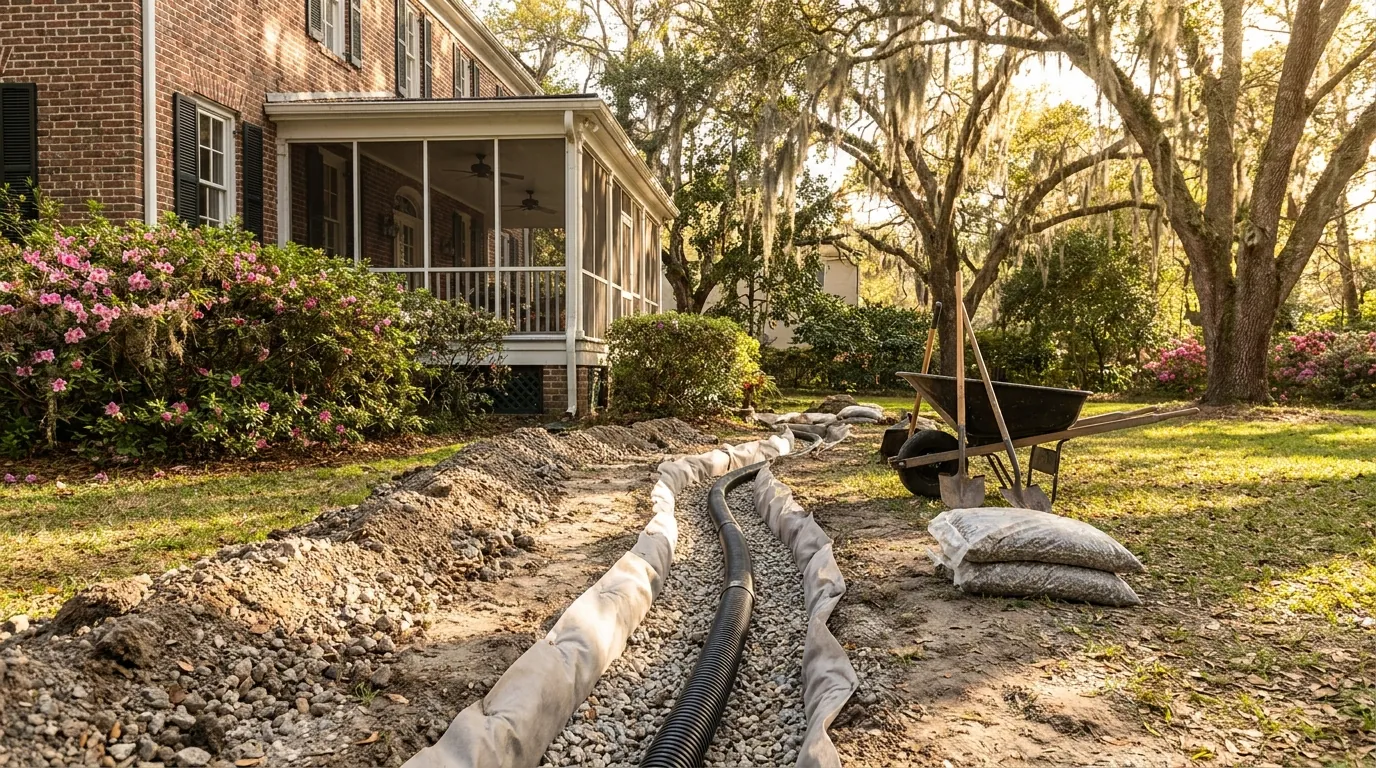
When a french drain is the right answer
A french drain is a gravel-filled trench with a perforated pipe at the bottom that collects water moving through and across the soil and carries it, by gravity, to a lower outlet. In Charleston that job is harder than the textbook version. Our soils run heavy to clay and compacted subsoil, and intense seasonal downpours dump more water than that soil can absorb. Instead of soaking in, the water perches near the surface and drifts toward the lowest point it can find — which is often the foundation of your house.
If you see standing water that lingers for a day or more after rain, soggy stripes of lawn that never fully dry, mulch and pine straw washing out of beds, or a crawl space that smells damp long after the storm, those are the signs a french drain is worth pricing. The point of the system is to give that trapped water an engineered path to somewhere it can safely leave, rather than letting it pool against slab edges, brick skirting, and planting beds.
French drain installation in Charleston starts with slope, not with digging. If there is no usable fall from the wet area to a legal, lower outlet, a trench full of gravel just becomes a buried bathtub. We look at where the water comes from, where it can realistically go, and whether a french drain alone is enough or should be paired with surface collection. See how it compares with other options on our surface catch basins and area drains page and with downspout extension and buried drain lines.
What the work involves, step by step
Every yard is different, but the sequence of a french drain install follows the same logic from survey to outlet.
-
Survey the fall and find the outlet
We shoot grades across the wet area to confirm there is enough drop to move water by gravity. Then we identify where it can legally discharge — a daylight point at a lower edge of the lot, a ditch, a storm structure, or a dry well where no daylight exists. The outlet decides everything else.
-
Lay out the trench and depth
The trench is routed to intercept water before it reaches the house and to hold a consistent downhill pitch the whole way. Depth depends on where the water is traveling — shallower for surface sheet flow, deeper where it is collecting a wet zone near a foundation.
-
Excavate and shape the trench
We dig to grade and check the slope along the run. In Charleston clay the trench walls hold well but the bottom must be graded carefully, because clay will not forgive a flat spot — water sits wherever the pitch stops.
-
Set fabric, gravel and perforated pipe
Filter fabric lines the trench to keep fine clay and silt out of the gravel. Perforated pipe sits in washed stone so water enters the pipe and runs downhill. Keeping sediment out of the stone is what keeps the system flowing in our silty soils.
-
Connect the outlet and backfill
The pipe is tied into the chosen outlet — daylight, pop-up emitter, or dry well — and the trench is backfilled with stone and capped with sod, gravel, or a decorative surface. We confirm flow at the outlet before we leave.
How Charleston soil and rain change the job
On sandier coastal lots water can percolate, and a shorter run to a dry well may be enough. On the heavy clay and fill common across the region, water barely moves down at all, so the drain has to catch it laterally and the outlet matters even more. We often find that a single french drain is only half the solution — downspouts dumping concentrated roof water at the foundation, or a yard that slopes back toward the house, will overwhelm any trench. That is why we pair drain lines with regrading or surface inlets when the site calls for it.
Charleston's rain also comes in bursts. A system sized for a gentle soak will back up in a summer cloudburst or a tropical system. We size pipe and gravel volume for the volume of water a given area actually sheds, and we keep the fall as steep as the lot allows so the line clears quickly between storms. For the money side of all this, our article on french drain installation cost walks through what drives the price up or down on a Charleston lot.
Get your yard looked at
If water is sitting in the yard or pushing toward the house, call to schedule a site visit. We will check the fall, talk through the outlet options, and lay out what the work would involve.
Serving Charleston and nearby towns including Mount Pleasant, North Charleston, and Summerville.
Frequently asked questions
How deep should a french drain be in Charleston clay?
It depends on where the water travels. For surface sheet flow a shallower trench can intercept it, while a drain pulling water away from a foundation or a persistent wet zone usually goes deeper. The constant is maintaining steady downhill pitch the whole way, because clay will not let water move on its own.
What happens if there is no low spot to drain to?
When there is no daylight outlet, water can be routed to a dry well or a pop-up emitter sized for the soil. On tight clay lots the dry well has to be large enough to hold water while it slowly releases. We assess this during the site visit before quoting a system.
Will a french drain fix water in my crawl space?
An exterior french drain can intercept water before it reaches the foundation and reduce what gets under the house. Crawl space moisture can also come from downspouts, grading, or groundwater, so we look at the whole water path rather than assuming one drain solves it.
How long does installation take?
A straightforward residential run is often completed in a day or two, while longer systems tied into multiple inlets or a dry well take longer. Wet weather and buried utilities can extend the timeline, which is why we lay out the schedule after seeing the site.