Trace the line and locate the failure
We map the drain's route and test flow from the inlet. Where water stops moving tells us roughly where to excavate, so we open the ground at the failure instead of along the whole run.
French drain repair in Charleston, SC. We trace failures, fix crushed pipe, clogged gravel, and silted outlets so your yard drains again.
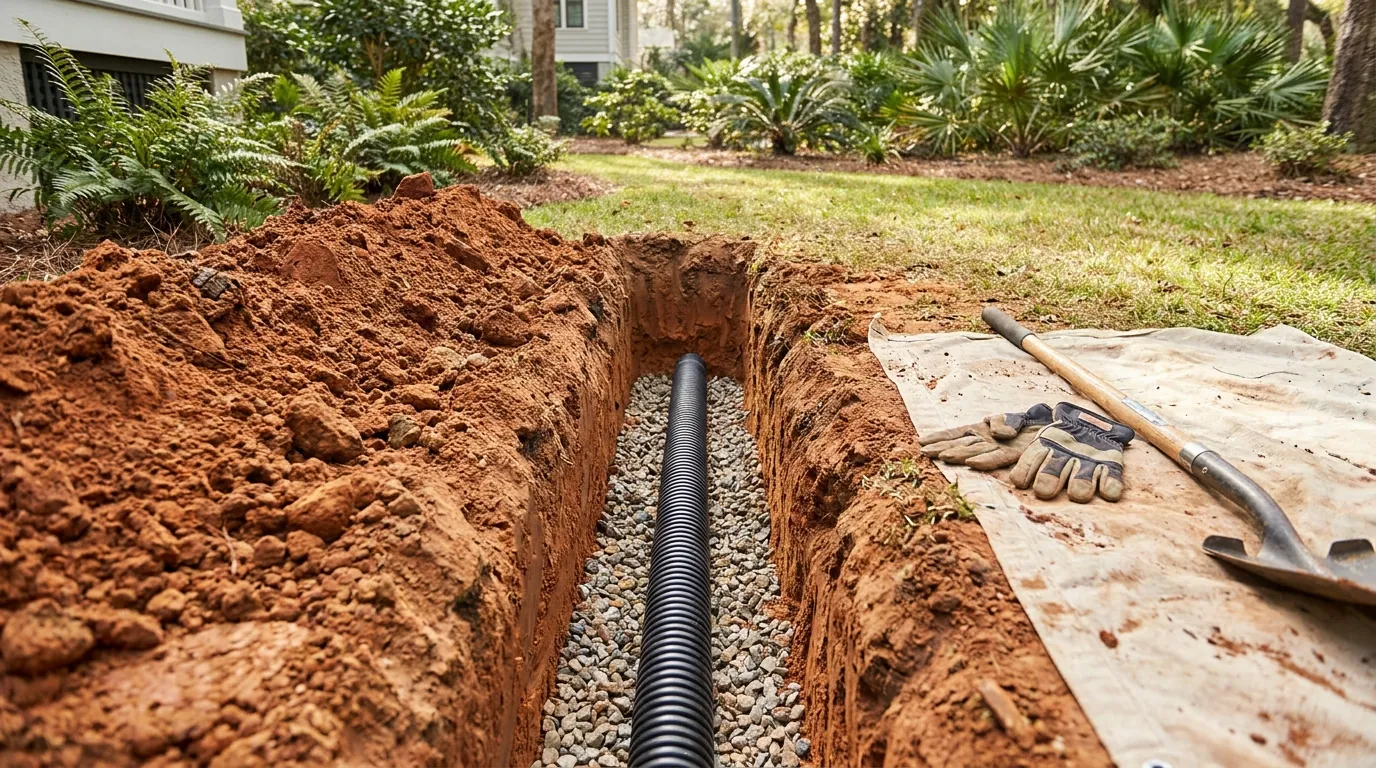
A french drain that no longer moves water is usually failing at one specific point, not along its whole length. The value of a good repair is finding that point before digging, so you pay to open the ground where the problem actually is. In the Charleston area, repairs cluster around a handful of causes: crushed pipe under vehicle traffic, roots invading a damp line, gravel that has silted up, and outlets buried by mulch or sediment.
The signs that you need repair rather than routine service are hard to miss. Water pools over the drain and stays for days, the outlet runs dry even during a downpour, or the lawn above the line has turned into a permanent wet patch. Sometimes a section of yard settles or sinks, which means the trench has lost its slope and water no longer has anywhere to go.
If you're not sure whether the problem is a full failure or just a drain falling behind, our french drain service page covers cleaning and diagnosis, and a site visit will tell us quickly which path makes sense.
Repair follows a sequence so we spend money digging only where the problem actually is.
We map the drain's route and test flow from the inlet. Where water stops moving tells us roughly where to excavate, so we open the ground at the failure instead of along the whole run.
We dig down to the pipe at the suspect point and confirm the cause: crushed section, root mass, blinded fabric, sediment packing, or lost slope from settling.
We swap out crushed or root-choked pipe, refresh gravel and filter fabric where it has clogged, and re-establish the correct fall toward the outlet so water moves again.
Because so many local drains fail at the discharge, we make sure the outlet daylights cleanly, is protected from mowers and mulch, and cannot silt back over.
We backfill in layers, reset sod or gravel, and flow-test the finished repair so you can see water reaching the outlet before we leave.
Clay-heavy soil is the biggest single factor in local french drain failure. Clay holds water against the drain and feeds fine particles into the gravel, and over years those particles can pack the void spaces the drain depends on. When that happens, water can't get into the pipe and simply sits above the line — the classic soggy strip that prompts a repair call.
The flat terrain compounds it. With so little natural fall, a drain that settles even a little can develop a low spot where water pools and sediment collects. Add heavy seasonal rain that pushes silt through the system faster, and outlets that clog when they daylight into a shallow ditch, and you have the repair patterns we see across Charleston, Mount Pleasant, and North Charleston.
Because we understand these patterns, a repair is also an opportunity to correct the original weakness rather than just restore the drain to how it failed. If the underlying design was never right for the site, we'll explain what a fresh french drain installation would fix and let you weigh repair against replacement.
If your french drain has quit moving water, reach out and we'll trace the line to find the failure point.
Repair work across Charleston, Mount Pleasant, North Charleston, Goose Creek, Summerville, Hollywood, and Ravenel.
Many drains fail at one section — a crushed length of pipe, a clogged outlet, or a settled low spot — and repairing that point restores the whole system. We only recommend replacement when the original design or widespread silting means a spot repair wouldn't hold up.
The most common causes here are fine clay silting up the gravel, roots invading the damp line, pipe crushed by vehicle or equipment traffic, and outlets that get buried and clog. Flat terrain that leaves little slope makes these problems more likely.
We trace the drain's route and test water flow from the inlet to see where it stops moving. That narrows the failure to a small area, so we excavate at the problem point rather than along the entire run.
We backfill in layers and reset sod or gravel over the repair, and because we dig only at the failure point, disturbance is limited. We also flow-test before finishing so you can see the drain working again.